Used Engines for Sale: How to Choose the Right Engine for Your Vehicle
August 20, 2026 • Used OEM Engines
Most people who get burned buying used engines for sale didn’t overpay. They bought an engine that looked right in the listing, waited four days for freight, and then found out at the shop that the crank sensor reads differently than the one their computer expects.
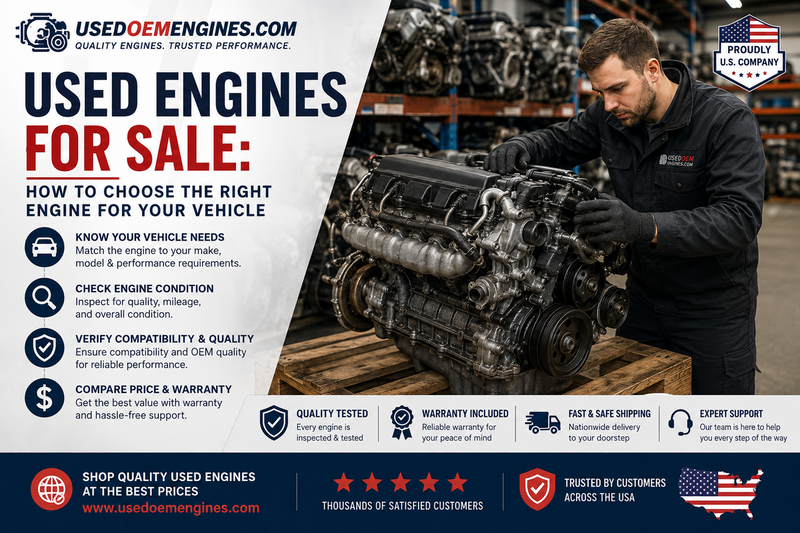
That happens more than you’d think. A model name tells you almost nothing about what’s under the hood. Plenty of vehicles offered two or three engine choices in the same year, and manufacturers quietly changed sensors, brackets, and reluctor wheels partway through a generation without touching the badge on the tailgate.
Start With Your Engine Code, Not Your Model Name
Your VIN gets you there fastest. On most US-market vehicles the 8th character identifies the engine, and that one character is the difference between a 4.8L and a 5.3L, or between a naturally aspirated four-cylinder and the turbo version of the same displacement.
A few other places confirm it:
- The underhood emissions label, which usually lists displacement and engine family
- GM RPO codes on the service parts identification sticker, typically in the glovebox, console lid, or trunk. LM7, LQ4, L92 and so on point to one specific engine
- Casting and part numbers stamped on the block, head, or intake. These matter most when the vehicle has already been worked on and you can’t trust the paperwork
Sellers who deal in used OEM engines will run an interchange lookup, which lists every application a given engine legitimately fits. That’s why an engine pulled from a different badge can still be the correct part for your car. Shared platforms, shared engines.
Know What You’re Buying: Short Block, Long Block, or Complete
Two quotes can sit hundreds of dollars apart and both be honest. One just includes more hardware. Compare configuration first, price second.
|
Configuration |
What’s Typically Included |
What You’ll Likely Still Need |
|
Short block |
Block, crankshaft, connecting rods, pistons |
Cylinder heads, valvetrain, intake, all accessories, gaskets |
|
Long block |
Short block plus cylinder heads, valvetrain, and usually timing components and cover |
Intake manifold, throttle body, sensors, accessories, oil pan in some cases |
|
Complete / dressed engine |
Long block plus intake, sensors, and often the alternator, A/C compressor, power steering pump, and manifolds |
Fluids, gaskets, and anything the seller lists as excluded |
Even “complete” gets stretched. Some yards pull the alternator and compressor to sell separately and still use the word. Others leave them on but won’t warrant them. Ask for a written list of what’s attached to the specific unit you’re buying, not the category blurb.
Ask about a core charge too. It’s a refundable deposit you get back when your old engine goes back to the seller, and it changes both your real cost and your schedule, since cores come with a return window.
Mileage Is a Data Point, Not a Verdict
A 90,000-mile engine that got its oil changed on time can be in better shape than a 60,000-mile engine that ran low on oil one summer. Odometer readings tell you how far something traveled, not how it was treated.
What you want to know is how the seller evaluated it. Reasonable checks include a compression test with the individual cylinder readings shared, a leak-down test to isolate whether the loss is rings, valves, or head gasket, a borescope look at the cylinder walls through the plug holes, and an oil pressure check with a look at the oil for coolant or metal. Best case, the engine was run in the donor vehicle before it came out. Nothing else tells you as much.
If all a listing gives you is mileage, that’s a question to ask, not a reason to walk. The seller who can’t explain how anything was verified is the one to avoid.
Used OEM vs. Rebuilt vs. Remanufactured vs. New
These four words get thrown around interchangeably and they shouldn’t be.
|
Option |
What It Is |
Practical Trade-offs |
|
Used OEM |
Original factory engine pulled from a donor vehicle, sold as-is or after inspection |
Factory fitment and factory materials at the lowest cost; condition varies unit to unit, so verification and warranty terms carry the weight |
|
Rebuilt |
Disassembled and repaired, with worn parts replaced as needed |
Scope varies enormously between builders. Ask what was replaced and what got reused |
|
Remanufactured |
Rebuilt to a defined specification, usually with machining and standardized part replacement |
More predictable than a general rebuild. Costs more, and lead times can be longer |
|
New / crate |
Never installed |
Highest cost, and simply not offered for a lot of older applications |
There’s no winner here in the abstract. A used OEM engine tends to fit the situation where the vehicle’s value doesn’t support a remanufactured price, where you want original components, or where the application is old enough that nobody builds new ones anymore. A remanufactured unit makes more sense for a vehicle you intend to keep a long time, or for an engine family with a known wear pattern you’d rather not inherit.
LS Engines for Sale: What Swap Buyers Need to Verify
The GM LS family covers the Gen III and Gen IV small-block V8s built from the late 1990s into the mid-2010s. They show up everywhere in the used market because GM put them in cars, trucks, and SUVs for close to two decades. That volume is exactly why people search LS engines for sale for swaps as often as for straight replacements.
The variants you’ll see listed
Gen III covers the LS1 and LS6 (5.7L aluminum), the LM7 and L59 (5.3L iron), the LR4 (4.8L iron), and the LQ4 and LQ9 (6.0L iron). Gen IV brings the LS2 (6.0L), the LS3 and L92/L76 (6.2L), the LS7 (7.0L), the LMG and LY5 (5.3L), plus the supercharged LSA and LS9.
Gen V is a different animal. The LT1 and its relatives are direct-injected and built on a different architecture. People lump them in with LS in conversation constantly, but they are not a drop-in equivalent, and buying one expecting otherwise is an expensive lesson.
Used Engines for Sale Near Me or Buying Shipped?
- Searching close to home is a fair instinct. You can put hands on the engine, sometimes hear it run, and there’s no freight bill or transit time. The limit is inventory. You get whatever that yard happens to have on the shelf, and terms range from a written warranty down to as-is with a handshake.
- Going national flips both sides. The pool of engines gets much bigger, which matters most when you need a specific code, a particular trim, or something more than fifteen years old. You generally get interchange matching against your VIN, written terms, and a documented return process. You also wait several business days for a truck.
- For a common late-model engine, the yard down the road might genuinely be your fastest path. For anything unusual, national inventory is what gets you an exact match instead of a close-enough one.
Receiving a freight shipment without regret
Engines travel strapped to a pallet on an LTL carrier, and the delivery itself deserves attention:
- Sort out whether your address counts as residential or commercial, and whether a liftgate is included. Most residential deliveries need one.
- Inspect the pallet before you sign anything. Look for shifted crating, an engine that tipped, and damage to the oil pan or accessories.
- Write any damage on the bill of lading right there at the truck. Once you’ve signed clean, a freight claim gets a lot harder.
- Photograph everything before you cut the straps.
Warranty Terms: Read the Conditions, Not Just the Duration
Duration is the headline. Conditions decide whether a claim actually gets paid. Nail these down before money moves:
- Parts only, or parts and labor
- Whether professional installation at a licensed shop is required
- Which items must be replaced during install, such as fluids, filters, gaskets, and timing components
- What documentation you’re expected to keep
- What the claim process looks like, and how long it takes
- Any mileage cap, or exclusions for commercial, racing, or modified use
Check these against the seller’s published policy for your specific purchase. Terms shift from seller to seller, and sometimes between engines at the same seller.
Mistakes That Turn a Good Purchase Bad
- Matching by model name instead of engine code is the big one, and it’s responsible for most returns.
- Close behind it: comparing a long block price against a complete engine price and deciding one seller is cheaper. You’re comparing two different piles of parts.
- Reusing worn ancillaries causes a lot of repeat failures. When an engine dies it often takes the radiator, cooling fan, or oil cooler lines with it, and bolting contaminated cooling parts to a healthy engine is a good way to kill it twice.
- Skipping the wear items at install is tempting when the bill is already high. Oil, filter, coolant, thermostat, plugs, gaskets, belt. Most warranties require them regardless.
- Not diagnosing the original failure is the costliest of all. A cooling fault, an oiling problem, or a fuel delivery issue doesn’t care that the engine is new to you.
- And signing for a damaged freight delivery without noting it on the paperwork. Ninety seconds of inspection.
Questions Worth Asking Before You Pay
- What’s the engine code, and which applications does the interchange cover?
- What mileage is on it, and how was that verified?
- Was it compression tested, leak-down tested, or run tested, and can I see the results?
- Exactly which accessories and components are attached to it?
- Is there a core charge, and how long do I have to return the core?
- What does the warranty cover, and what conditions apply?
- How does it ship, how long is transit, and does delivery include a liftgate?
- What happens if it turns out not to match my application?
Your Next Step
Pull your VIN and find the 8th character before you request a single quote. Confirming your engine code takes about a minute and eliminates most of the fitment problems buyers run into.
With that in hand, you can check availability for your engine code and application and compare offers on a level basis: same engine, same included parts, same terms.
FAQs
How many miles is too many on a used engine?
There’s no universal cutoff. How the engine was maintained and how it was evaluated tell you more than the odometer does. A higher-mileage engine that passed compression and leak-down testing is often the safer buy compared to a low-mileage one with no history behind it.
Do I need the exact same engine code as my original?
Usually, yes, or an engine listed as a verified interchange for your application. Two engines can share displacement and still differ in sensor location, computer requirements, and accessory mounting.
Is a used OEM engine better than a remanufactured one?
They answer different problems. Used OEM gives you original factory components at a lower price. Remanufactured is built to a defined spec and suits a vehicle you plan to hold onto. Compare how each was verified and what the warranty says instead of trusting the category label.
Can I put an LS engine in a vehicle it never came in?
It’s one of the most common swaps out there, but the engine by itself won’t get you running. Expect to need a compatible harness and PCM, the right accessory drive, an oil pan that clears your crossmember, mounts, and an exhaust plan. Settle the reluctor count and throttle type early, because most of the other decisions follow from those two.
What should I replace during installation?
At minimum, oil and filter, coolant, thermostat, spark plugs, and gaskets. Inspect the radiator, fan, hoses, and oil cooler lines closely if overheating had anything to do with the original failure. Some warranties require specific items, so read the terms before the engine comes off the pallet.
How do used engines ship?
Strapped to a pallet, moved by LTL freight. Residential addresses usually need a liftgate. Inspect before signing and note any damage on the bill of lading.